
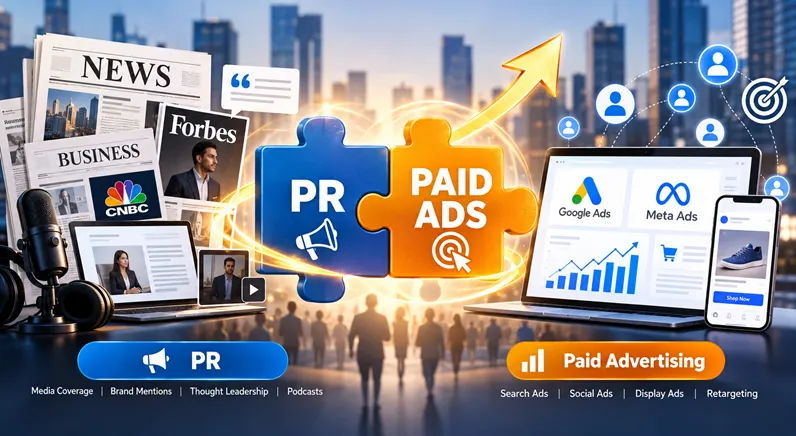
Most businesses treat paid advertising and PR as two separate budget lines doing two separate jobs. The media team handles coverage. The performance team handles ads. The two rarely speak to each other in any meaningful way and the results of both suffer for it.
The relationship between PR and paid advertising is not just complementary. It is multiplicative. Brands with strong PR get measurably better returns from their ad spend than brands without it. Any experienced PR agency in India will tell you that understanding why changes how both functions should be resourced and run.
What Happens Before Someone Clicks Your Ad
Digital advertising operates on an assumption that most performance marketers do not examine closely enough. It assumes that the moment of the ad is the moment of decision. In reality, the decision to click, and more importantly the decision to convert after clicking, is shaped significantly by what a person already knows or feels about a brand before the ad appears.
A person who has seen a brand mentioned in a publication they trust, heard a founder speak on a podcast they follow, or come across a positive editorial reference somewhere in their research journey, responds to that brand’s ad differently from someone encountering it for the first time through a paid placement. The former has a context for the brand. The latter has only the ad’s claim about itself, which carries the credibility of any self-promotional message, which is to say very little.
PR builds the context that advertising then activates. Without that context, advertising works harder for worse results. With it, the same ad spend produces meaningfully better conversion rates because the audience it reaches is not starting from zero.
The Trust Gap That PR Closes
There is a trust gap between a brand that exists only in paid channels and one that has earned third-party editorial coverage. Consumers and B2B buyers have spent years developing sophisticated skepticism about advertising. They know the brand paid for the placement. They know the message has been crafted to persuade. That knowledge creates a resistance that even well-executed creative has to overcome before any selling can begin.
Editorial coverage does not carry that resistance in the same way. When a journalist writes about a brand because the story is genuinely interesting, when a publication features a founder because their perspective is worth reading, the reader receives that information differently. The trust is borrowed from the publication and transferred to the brand.
When a paid ad appears to someone who has already encountered that brand through editorial coverage, the ad is not introducing the brand. It is reminding someone of a brand they already have a positive association with. A good PR agency in Delhi understands this dynamic and builds it into how they approach media strategy for clients running paid campaigns alongside their PR work.
Retargeting Works Harder on a PR-Warmed Audience
Retargeting campaigns, which show ads to people who have previously visited a website or engaged with a brand’s content, are one of the most efficient forms of paid advertising when the audience being retargeted is genuinely interested rather than just accidentally present.
PR drives a specific kind of website traffic. People who arrive via an editorial mention in a publication they trust are arriving with intent and positive predisposition. They read about the brand somewhere credible and came to find out more. When retargeting ads follow that audience, they are reaching people who are already partway through a trust journey rather than people who landed on the site by accident.
The difference in conversion rates between retargeting a PR-driven audience and retargeting general traffic is significant enough that brands with strong PR programmes effectively get more from the same retargeting budget than brands without one. The ad spend is identical. The audience quality is not.
Brand Search Volume as a PR Indicator
One of the clearest signals that PR is doing work for paid advertising is what happens to branded search volume after a significant piece of coverage. When a brand is featured in a prominent publication, mentioned on a widely listened to podcast, or covered in a story that gets shared across social platforms, searches for the brand name typically increase in the days that follow.
That increase in branded search represents an audience that paid advertising can now reach far more efficiently. People searching for a brand name are not browsing passively. They are expressing active interest that was created by the PR moment they just encountered. Paid search campaigns that capture this branded traffic are converting intent that PR created, at a cost per acquisition that generic keyword targeting cannot match.
Brands that track the relationship between PR activity and branded search volume over time develop a concrete, commercially legible picture of what their PR work is producing. For businesses trying to make the case for PR investment internally, this data point is often the most persuasive one available.
Building the Integration
Getting the full benefit of the PR and paid advertising relationship requires the two functions to be genuinely integrated rather than merely coexistent. The paid team should know when significant coverage is coming so campaigns can be timed to capture the interest it generates. The PR team should understand which audience segments the paid team is trying to reach so media targeting can be aligned.
Whether you are working with a PR agency in India or building an in-house function, both teams should be looking at the same conversion data so the contribution of each to shared outcomes becomes visible. Twenty7 Inc. builds this kind of integration into client engagements because the brands that get the best return on their total marketing investment are the ones where PR and paid advertising are working from the same strategy rather than parallel ones.